Increasing Participation of Refugees in European schools
Project Number: 2023-1-ES01-KA220-SCH-000166694

Booklet of Good Practices
-
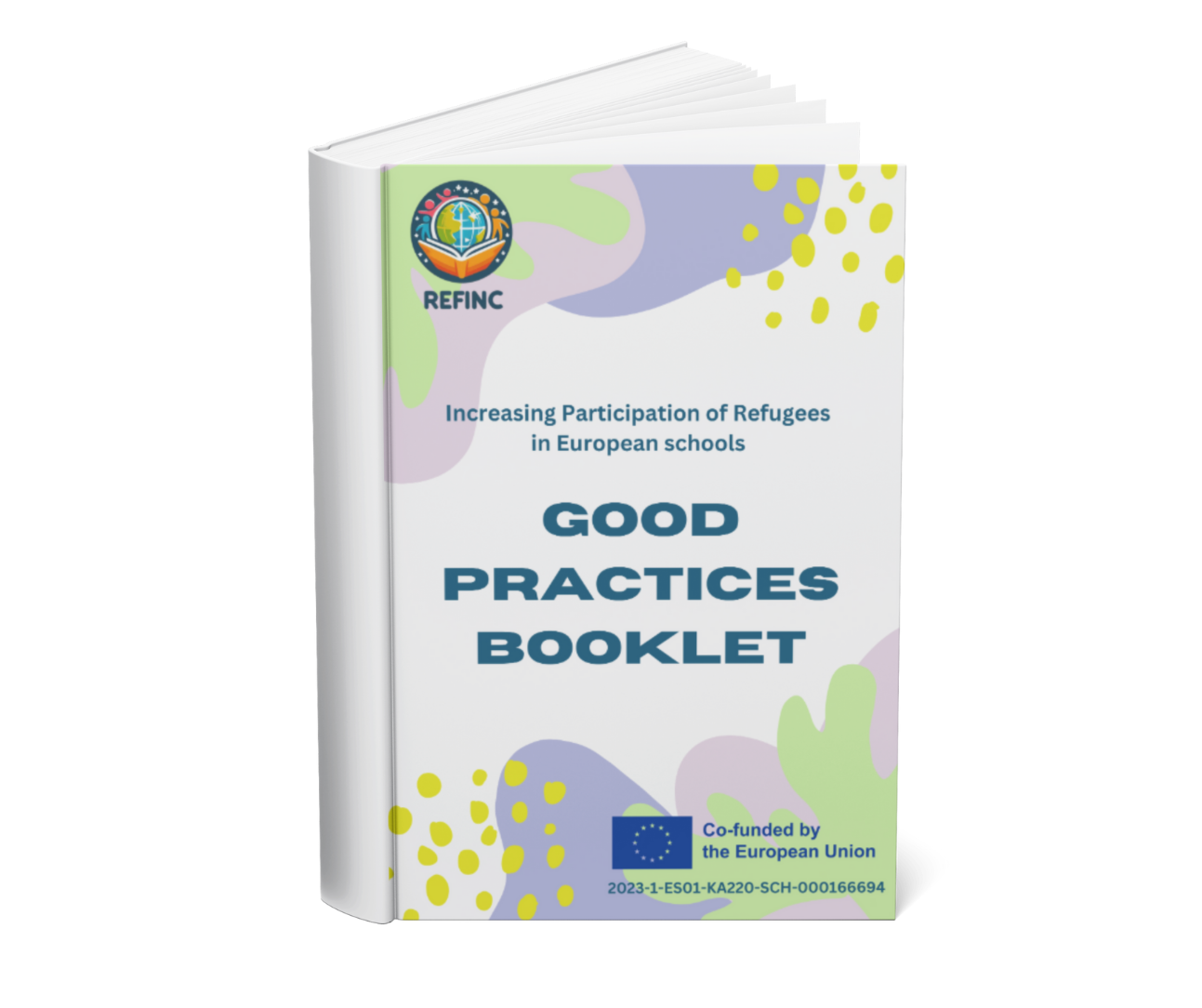
The REFINC Booklet of Good Practices is a comprehensive analytical compilation of effective pedagogical, social, and institutional practices for inclusion of refugee and migrant students in European schools. It has collected, documented, and synthesized 30 examples of successful interventions from six partner countries, identified through structured qualitative interviews with teachers, school management, and local education stakeholders. The publication will include comparative commentary, methodological classification, and contextual guidelines for adaptation.
-
The main objective is to establish a solid knowledge base of evidence-driven and field-tested approaches that have demonstrably improved participation, retention, and psychosocial integration of refugee pupils. The booklet aims to strengthen teachers’ and school leaders’ capacities to design their own inclusion policies and learning environments, relying on validated European experience.
-
The booklet will serve as a methodological reference for:
school boards developing inclusion frameworks and action plans;
teacher trainers designing professional development modules;
NGOs and municipalities formulating local education integration strategies.
It can be used in pre-service and in-service teacher training, or as supporting documentation in developing school development plans related to inclusion and diversity.
-
The publication addresses the fragmentation of good practices across countries and the absence of structured, transferable models. It provides a verified repository of methods and tools ready for replication, significantly reducing the cost and time of designing inclusion initiatives. It also strengthens European coherence by aligning local efforts with EU policy on inclusion and diversity in education.
REFINC Educational Content for Teachers and Schools
-
This result consists of a structured set of training modules and learning units focusing on intercultural communication, trauma-informed teaching, empathy-building, and participatory classroom methods. It will form the theoretical and practical core of the project’s training system. Each module will be developed collaboratively by experts from partner institutions, reviewed by the internal evaluator, and validated by an external expert panel in pedagogy and refugee inclusion.
-
To enhance the professional competence of teachers and youth workers in addressing the complex educational needs of refugee and migrant students. The content aims to improve teachers’ ability to create inclusive learning environments and to respond constructively to cultural diversity, emotional distress, and language barriers.
-
The modules are integrated into blended learning sessions during the Learning, Teaching and Training Activities (LTTAs) and later embedded into school training programs. Each is accompanied by guidelines, reflective exercises, and assessment tools. Schools will be able to adapt the content for internal workshops, mentoring programs, or initial teacher training curricula.
-
The educational content is designed to fill a crucial gap in teacher preparation. Most teachers in Europe have limited access to structured learning materials on refugee inclusion. By offering coherent, research-informed modules, this result ensures quality assurance, transferability, and measurable competence development across the partner countries.
REFINC Training Toolkit – “Train the Teacher for Inclusion”
-
A practical, action-oriented toolkit combining digital and physical resources to support the implementation of teacher training on refugee inclusion. It includes session plans, step-by-step facilitation guides, reflection templates, checklists, monitoring tools, and interactive exercises. The toolkit operationalizes the REFINC educational content into a ready-to-use package for schools and training centers.
-
To provide teachers and school trainers with operational tools for conducting participatory training sessions in their own institutions, ensuring multiplication and sustainability of project outcomes. The toolkit’s structure follows a “learning-by-doing” and experiential education approach, promoting emotional safety and intercultural empathy among educators.
-
The toolkit will be distributed digitally and physically, tested in pilot schools during national workshops, and later used by partner schools to train additional teachers (a minimum of 35 per partner country). It can be applied in continuing professional development, Erasmus+ staff trainings, and intercultural education initiatives. The toolkit will also include guidelines for local adaptation, ensuring compatibility with national curricula.
-
It transforms theoretical knowledge into actionable pedagogy. By offering a replicable and adaptable training framework, the toolkit ensures large-scale institutional uptake and long-term systemic change. It is also cost-efficient, supporting low-resource schools in implementing inclusive practices without dependence on external trainers.
REFINC Online Learning Platform
-
An interactive e-learning environment hosting all project results in an integrated digital format. The platform will include the educational content, training toolkit, digital versions of the booklet, and self-paced learning modules. It will provide open access to all stakeholders, ensuring the continuity and dissemination of project outcomes beyond the project duration.
-
To extend the project’s reach through digital means and to make inclusion training accessible to teachers, students, and youth workers who cannot attend face-to-face activities. The platform contributes to the creation of an inclusive digital ecosystem supporting lifelong learning.
-
Users can register freely, access learning paths, download materials. Partner institutions will use it as a digital extension of their local training systems, enabling blended learning and transnational collaboration.
-
The platform guarantees sustainability and large-scale impact by turning the REFINC methodology into a reusable and scalable open educational resource. It ensures the project’s legacy and reinforces Erasmus+ priorities on digital transformation and open access education.
Funded by the European Union. Views and opinions expressed are however those of the author(s) only and do not necessarily reflect those of the European Union or the European Education and Culture Executive Agency (EACEA). Neither the European Union nor EACEA can be held responsible for them